Build · Renovate
Money moves when the work does.
Construction goes wrong in a predictable order: a vague quote, a large advance, and then a conversation you cannot win. We took the advance out of it.
Where your money is, at every point.
Five stages. The right-hand column is the only part most people actually want to know.
- 01Nothing has moved
You describe the work
A plot, a floor plan, a renovation. Nothing you fill in carries a rate — you are describing the job, not pricing it.
- 02Nothing has moved
Contractors quote, item by item
Cement, steel, labour, finishes: quantities and a price against each. Two quotes for the same job can be read side by side because they are itemised the same way.
- 03Held in escrow
You fund a stage, not the job
The money for the next milestone goes into an escrow account. It is out of your hands and it is not in the contractor's either.
- 04Still held
The work happens and somebody looks at it
A milestone is inspected the same way a home is: our person on site, photographs fingerprinted where and when they were taken.
- 05Released
The stage passes, the stage gets paid
A release needs a passed inspection behind it. If the inspection has not happened, there is nothing to release against.
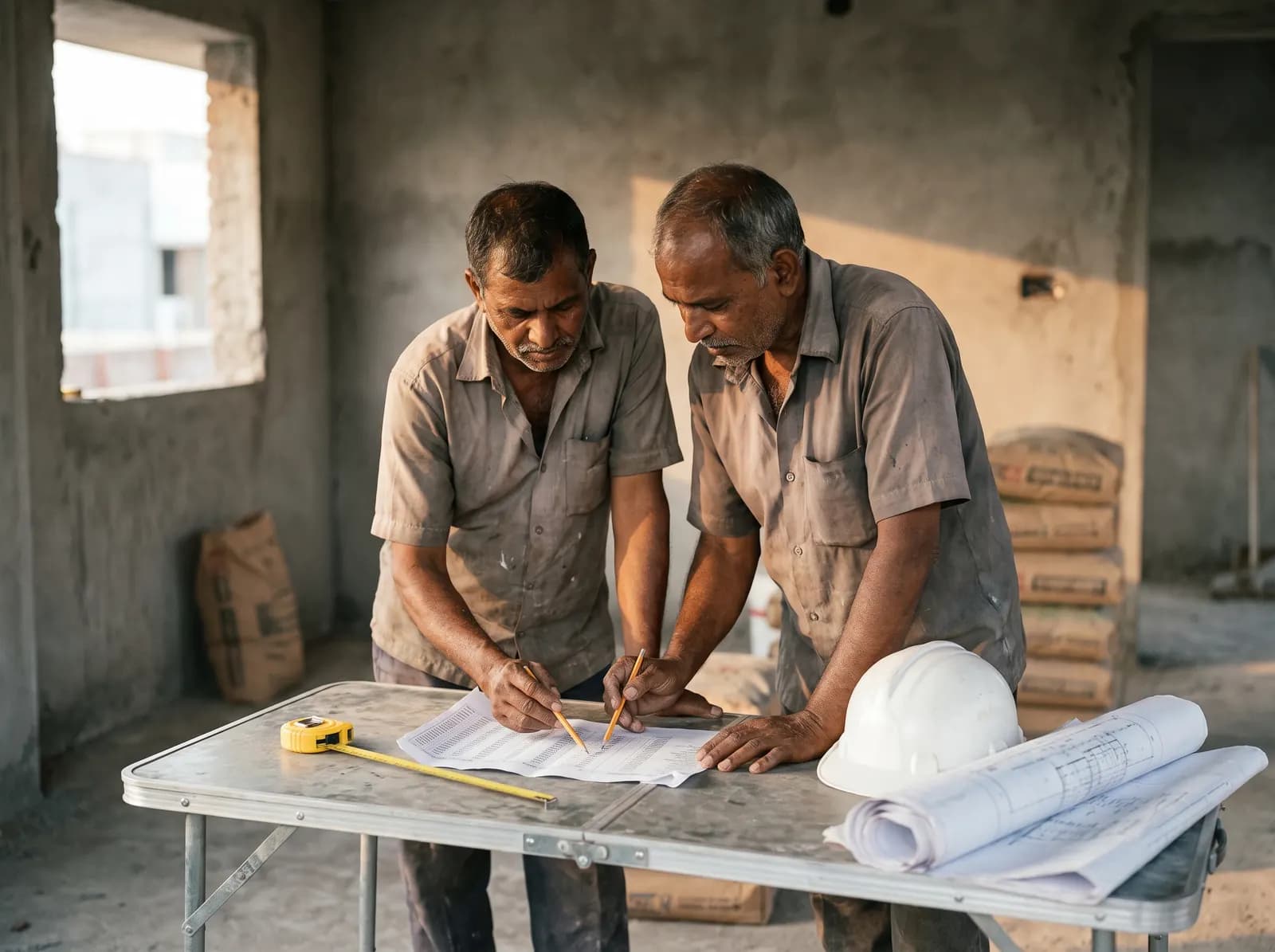
The quotation
A number you can argue with.
“Eighteen lakh, all in” is not a quotation. It is a number with nothing underneath it, and there is no honest way to compare two of them.
Here a quote is a list. Each line has a material or a task, a quantity, and a price for that quantity. If two contractors have priced the same job differently, you can see the line where they disagree — usually steel, usually the grade.
We do not publish a rate card, and the forms you fill in do not contain one. Prices come from contractors competing for your job, which is the only place a real price comes from.
Rules, not intentions
Four things that are not up to either of you.
These are not commitments we are asking you to trust. They are conditions the system checks before it will do anything, which is a different kind of promise.
The contractor is never paid in advance
Not a norm we encourage — a thing the system will not do. Money reaches a contractor after a milestone has been inspected and passed, and by no other route.
Nothing can be released that was never funded
The escrow account cannot pay out more than has been put in. It is checked on every single release, so an overdraft is not a possible state rather than an unlikely one.
Neither of you can change the deal alone
A change to scope or cost sits open until both sides confirm it. A contractor cannot quietly add to the bill, and you cannot quietly cut the scope after the work is done.
Areas are calculated, not typed in
Plot and built-up areas are worked out from the dimensions rather than accepted from a form. The number a quotation is built on is not one somebody rounded up.
The contractors
Registered, or not here at all.
A contractor does not appear on this marketplace until their GST registration has been checked. Until it clears they can hold an account, and nobody can find them.
It is a low bar deliberately — it is not a judgement of their work. What it removes is the man with a phone number and no business behind him, which is who you are most exposed to when a job goes wrong and you want somebody to be accountable.
Beyond that, contractors carry the same site-visit record as everyone else: the inspections on their past jobs happened where and when they say they did.
Building something, or taking on the work?
We are not open to the public yet. Tell us what you do and we will come back to you when there is something worth showing you.